Miracle 2024

The year-end holiday season.

In America, it is said that miracles happen during the year-end holidays- Christmas.

One of my favorite quotes is, “there are two ways to live life. One is as though nothing is a miracle.  the other is as though everything is a miracle.” Albert Einstein, 1879~1955

Several miracles happened this year as well.

I want to share with you about a Christmas miracle that happened in my house.


On December 6th, after my usual walk with my dog ​​family, my oldest dog, Lumi, developed a severe heart attack, was breathing heavily, and couldn’t move at all. All I could do was stay by her side.

I applied Animal Reiki, meridian acupressure on her heart and lung pressure points, and administered four drops of Bach Flower Rescue Remedy every 5 minutes.

The youngest puppy, Makani, who is very attached to Lumi, came next to Lumi and watched over her.

Lumi couldn’t move, but she was doing her best.

I video-called my husband, Eric, and let Lumi hear his voice.

Lumi said she would wait for Eric’s father to come home, but Lumi passed out after the call.

Her eyes remained open, unfocused, and unaware of my words and actions.

Lumi turns 15 next month, so I couldn’t help but think this was her last moment.


(Two years ago I wrote a blog about how Lumi came into my life on Lumi’s 13th birthday.)


I took a deep breath, calmed down, remembered what I had learned from raising a family of about 20 animals over the past 30 years and helping many rescue animals as an animal rescue volunteer, and did what I could.


Miraculously, Lumi regained consciousness several hours later.

But she was still breathing heavily and couldn’t move at all, so I communicated with Lumi and told her, “If you need to go to heaven, I will mentally prepare.”

Then Lumi said, “I am still here, Mommy. I am not going anywhere; I would wait for Daddy.”


When Eric came home, Lumi was weak, but she was happy to see him and show the strength of her life force and her presence through her eye movement.

Lumi couldn’t drink or eat anything, so we made her therapeutic drinks and liquid food. Lumi took a little bit of both.

After Lumi had the drinks and food, she seemed calm. I asked Lumi how she felt, and although it took a while for her to respond, she answered, “I didn’t know what was going on, and I couldn’t breathe, so I was scared.”

So I said, “Yeah, it was scary, but it’s okay now. You are still with us.”

I won’t go anywhere and will stay by your side. ” Then Lumi slowly closed her eyes, her breathing calmed down much more, and she fell asleep.

Lumi was going through living and dying and is trying her best to get better through the transition period, so I made a mixture of Bach Flower Remedies for Fear and Transition and sprayed it around Lumi and over her pows every 15 minutes.


I decided to make my bed next to her on the living room floor and sleep on the floor with her.

The first night, she breathed heavily when my hands left her, so I gave her Reiki or a gentle rub, and then she fell asleep for a little while.


I put a diaper on Lumi so she could lie down if she needed to pee or poop, but Lumi kept trying to get up in the middle of the night, and her breathing got worse every time.

But Lumi was stubborn and didn’t want to use diapers, so I didn’t know what to do. When I thought about it, I realized that if I were Lumi, I might be the same, so I thought about what I could do for Lumi. I picked her up and carried her outside the garden.


At that moment, Lumi was breathing very heavily and her heart was beating so fast that I could hear it, and I was filled with fear that Lumi’s heart might stop beating. I started blaming myself for taking Lumi outside, and when I closed my eyes, I realized that the sound of that heartbeat was also my own. So I took a deep breath and opened my eyes. I saw Lumi trying her best to find a place to pee, and I could tell that Lumi was doing her best even in times like this, so I told myself to ignore my whining. The only choice I had was to do everything I could to support Lumi.


Suddenly, I gently hugged Lumi and said, “I’m with Lumi. I love you!”

Then, Lumi’s heartbeat became a little quieter, and she found a place to pee and was looking toward the house, so I carried her back inside.

After that, Lumi asked twice to go outside, so I did the same thing for her, and at dawn, she seemed to be able to sleep soundlessly.

I was able to do what I could for her, just out of love, without doubt, or worry thinking.


I contacted Dr. Lane, a holistic veterinarian, but she was unavailable due to the holiday season, so the next day, I called Nancy, an animal healing specialist at Santa Monica Homeopathic Pharmacy, to discuss Lumi’s condition, and Eric got some homeopathic medicine.


Lumi had already been diagnosed with a heart murmur by Dr. Lane and has been taking herbal and homeopathic medicines for that purpose. After this episode, I suspect that Lumi may have fluid buildup in her lungs and heart, just like Lumi’s daughter Happy, who passed away in February this year. That’s why I decided to have Lumi balance out fluid in her heart and lungs.

We got heart medication, the fluid resolved, and we continued giving her Bach Flower, animal Reiki, massage, animal communication, and meridian point acupuncture with moxibustion.

We decided to try to improve Lumi’s health through all remedies, homeopathic medicine, healing foods, and our love.


Lumi still has a strong will to live.

Lumi’s health condition has been improving.

Thanks to her determination and our family’s efforts, Lumi can now eat her favorite mochi (soft rice cake) in the morning and eat homemade food (not more liquid food) and slowly walk out of the garden on her own.

The other day, she was determined to walk outside our yard, so I took her for very short walks. When Lumi gets tired, she tries to return instead of moving forward, so I respected her wishes and returned home immediately.


Lumi wanted to see Ocean on Christmas day.


Lumi said hello to everyone she passed, lay down on the sand, and enjoyed feeling the breeze.


On the way back, Lumi seemed a little tired and wouldn’t move on the sand, so when I held her, she was happy. She walked along the sidewalk on her own, sniffed many scents, and was satisfied.

Even as I write this blog, Lumi is sleeping comfortably with Makani at my feet, and when I tried to take a photo, Makani looked up.

Our Christmas miracle in 2024!

I hope you all find miraculous moments as we enter the new year.


Love, 

Sanae ❤️


*Bonus:

What I found out about dog heart murmur.

“A dog with a heart murmur may experience a seizure-like event called syncope, which is a temporary loss of consciousness:

Syncope – Also known as fainting, syncope can occur when a dog’s heart is unable to pump enough oxygenated blood to the brain. This can be caused by an abnormal heart rhythm or arrhythmia, which can be very fast, very slow, or irregular. Syncope can look like a seizure, but there are some key differences.

Japanese Loquat Leaves and Pine Needles Tincture-Making Workshop

My mother made loquat tinctures for the last 20 years of her life.

As long as I remember, my mother had a weak immune system from a young age and was not able to get up in the morning to make breakfast. She could not gain weight for many years and sleep well.

My mother was in pain all over her body and took a lot of prescription drugs, so she may have always been looking for what she could do to improve her health.

My mother tried many recommendations from her friends, neighbors, and local news sources, but nothing helped her.​

For example, eating prunes, drinking noni juice, eating more meat and only chicken to gain weight, buying expensive electric blankets, worshiping a group of people and buying white china from them for a lot of money. The group told her that worshiping it would improve her health.

I had already been practicing macrobiotics and knew that it would not improve her health, but since I lived far away overseas, I always listened to her with love. When I returned to Japan, I cooked a hearty macrobiotic meal for her. As I did this, my mother’s health started to improve, so I found someone to cook macrobiotic meals for her several times a week, and my mother’s mindset became more positive and she stopped trying so many different things.

One day, my mother called me to tell me that her pain was relieved and she was able to sleep better thanks to the loquat leaf moxibustion and loquat leaf tincture (extract).

Shortly after that, my mother received some loquat leaves from a friend and started making her own loquat leaf tincture.

She got loquat leaves from her friends and made loquat tincture herself.

To make a tincture, she had to separate the leaves from blanches, clean each, cut them, and put them in a glass bottle with shochu.

It was lots of work, but she was determined to make it. She was tired but enjoyed the aroma of loquat leaves and looked vibrant in the photo she sent me.

Viblant my mother after she started to make Loquat tincture and using it.

She even planted a loquat tree in her yard. She told me if there is a loquat tree in America I need to plant it, too.

Fortunately, there was a large loquat tree next door to the house I moved into around that time (where I still live today), and I received a loquat seedling from there, which I planted in my garden 30 years ago.

My mother many bottles of Loquat tinctures and sent me her loquat tincture many times, and I have used it all for me, my husband, animal family, friends, and clients.

I started to make my own when my loquat tree got big enough.


Making tincture is a gift my mother gave me; I want to share the gift that my mother gave me with as many people as possible. Now I make many other different tinctures.
After I decided to offer this workshop, I remembered that when I was about 3 years old, my grandmother took me to the mountains of Mie to forage wild mushrooms and medicinal plants. My grandmother was a healer. I finally understand why I am so drawn to the power of nature and healing work.

The life I genuinely dedicate is to honoring and healing the great force of nature with my body, soul, and spirit and helping others and their animal families heal as well.

I am grateful to JACCC Emi Osaki for giving me an opportunity to teach the Japanese Tincture Making Workshop. 


Here is the detail of the workshop:

Join JACCC and Sustainable Little Tokyo for an immersive, hands-on workshop where you’ll explore the art of crafting botanical tinctures using Japanese loquat leaves and aromatic pine needles. Experience their unique scents, learn how to safely apply them to your skin, and create your personalized tinctures to take home. Along the way, you’ll gain insight into these plants’ numerous benefits and traditional uses while also mastering techniques that will empower you to make tinctures with herbs from your garden.

When: Sun, Oct 27, 2024, 10:30 am –  12:00 pm

Where: Toshizo Watanabe Culinary Cultural Center

244 S. San Pedro Street, Los Angeles, CA 90012

Price: Free with RSVP (donations encouraged)

Japanese Botanical Tincture-Making Workshop

Who Gose Slowly Goes Far

When I was a child (around elementary school), I never thought about knowing anything about myself.

So I just believed what the adults – my parents, my grandparents, my aunts and uncles, my school teachers – said about me, and I didn’t realize what I was feeling.


I was not good at creating things quickly, writing quickly, or implementing them immediately. The adults around me called me “NOROMA”(it means SLOW) because I started everything leisurely and couldn’t finish it on time. “Noroma” also means “not attentive” in Japanese, which didn’t sound positive. Therefore, I believed that I was not good at creating or implementing something.

As a result, I can’t count the number of times I’ve given up on creating something or stopped before it was completed.

I learned crochet and embroidery in elementary school between 9 and 12 years old. 

However, I could hardly complete any projects at school.

First, think about what to make, what color to use, and what kind of thread to use.

By the time I finally decided to start, everyone else had already finished about half of it. That’s why I was so behind that I couldn’t complete it at all in the classroom. 

I could have finished it at home, but I didn’t.

Why?

That’s because my parents’ home didn’t have an atmosphere of art or crafts at all. I’ve tried making something at home a few times, but when I did, they would say, “You’re making a lot of trouble. You can’t finish it.” Or, “Why did you take so long to make it?” so I didn’t want to do anything at home.

Of course, I did not know if I could make it or not, but I wanted to try with my best ability. However, I felt that my family did not support me, so I did not want to do anything at home.

But that didn’t mean I completely lost my passion for creating things. It took me many years, but I started to do some simple knitting, do pottery, do stained glass, and do a little gardening.

When I started studying macrobiotics after I got ovarian cancer, I realized that I could take the time to cook according to the five seasons, and I thought I could do this. Carefully wash whole grains, brown rice, etc. and cook them slowly over time in a ceramic or stainless steel pot instead of an electric kettle. It was perfect for me, as I gently washed vegetables, cut them with care, and cooked them. I enjoyed studying and learning a lot.

I like weaving, knitting, crocheting, and sashiko projects, as well as calligraphy, wood carving, natural dyeing (using organic indigo, herbs, and flowers), natural ink making, mosaics, stained glass, woodblock prints, making miso, Japanese umeboshi plums, grow organic plants and more.

I started enjoying my favorite things in my spare time from work, such as watercolor painting and growing my favorite medicinal herbs in my garden after I recovered from ovarian cancer.

As I got older and started to enjoy a slower life, I’ve started working in between doing my favorite things, which is the opposite of what I used to do.

By doing something I like even a little bit every day, I realized that since I was a child, I actually like things that take time to make. I found myself enjoying taking my time and being careful, and carefree about my time.

I found that I felt most comfortable going slowly. 

I do not mind being careful “NOROMA”.


I’ve joined Wildfiber Studio‘s sweater club about seven years ago. Slowly over the past five years, have learned and perfected how to knit and crochet many sweaters and cardigans. 

Read More…

Birthday Wishes and Gifts

A birthday card arrived in the mailbox.
It came from my longtime friend J, whom I met while attending Pepperdine University (45 years ago).

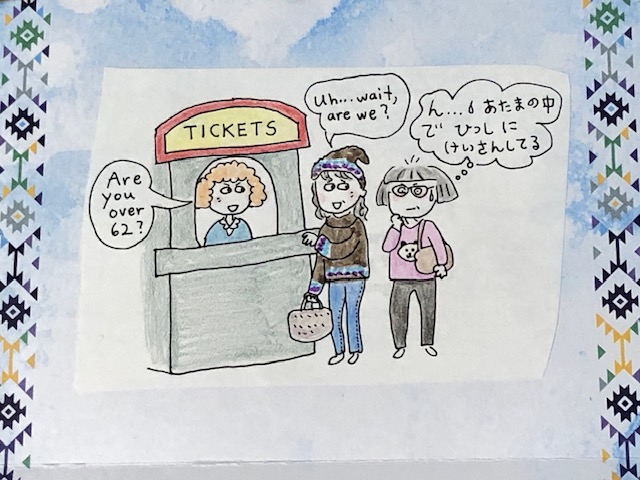
She drew a scene where we recently saw a movie on the card.
The scene is as follows:
Eric was buying our tickets, and the person selling them asked my friend J and me if we were over 62.
She and I are the same age, and we looked at each other and asked each other, “Huh? How old are we?”

We could not think of our age at that moment right away, and we laughed so much. Receiving this card made me laugh so much again.

It is so wonderful to age well.
Most of the time, we can’t even remember how old we are because we usually feel young and have much fun without paying attention to how old we are.
I’m fortunate to have a best friend like J.


Come to think of it, a long time ago (probably more than 30 years ago), I was talking with my friend “J” on the sidewalk when an elderly woman walked past us and said, “Age before beauty!” I remembered.

I had never heard the phrase “age before beauty” before, so I asked J, who was an English major, what it meant.
I don’t remember exactly what J said- but it meant something like “Age is more valuable than youth or beauty.”
I didn’t realize its true meaning until recently, but I’m finally at the age where I can tell young people about the value of growing older.

That getting older is not just about numbers.
Of course, the reality is that aging is physically more challenging, and mentally, it can be lonely and scary times.
But that’s why I feel so strongly that it’s essential to make the most of my abilities and live daily with self-love and self-care.
As I age, I am convinced that my experiences have made me a wiser person, and I can say that I like being the way I am.


Well, I didn’t do anything special for my birthday this year.
As usual,
– Morning walk with the dogs
-Hand-sewing the pants length for a new gardening jumpsuit
– Aquatic plant gardening
-Watched a movie and cuddled cats
-Eric took me out for my birthday dinner
-In the end, I went to the sea at night when no one was there and very windy (Lumi’s ears are flying because of wind)


– Talk to Eric about my future plans.
– I took a bath with homemade medicinal herbs and fell asleep well.

The best part was that I felt a special, soft vibe and was grateful for being born.
Spending my birthday slowly like this was perfect for me right now.


Some of you may know that I have had some difficult experiences in my life.
Attempted suicide when I was 14 years old.
Moved to the United States at the age of 19.
Stopped drinking alcohol at the age of 29 and have continued to do so.
Diagnosed with ovarian cancer in 1993 and recovered in 1995.
Survived a near-death car crash in 2001, and was able to walk after four years in a wheelchair.
In 2019, began recovering from stage IV non-Hodgkin’s lymphoma cancer, despite being diagnosed with only weeks to live in 2017.

My birthday wish is to respect “Sanae,” who has chosen this life and is striving to fulfill the life she has been given.
Maintain good health by caring for my body, mind, spirit, and soul.

As my birthday gifts, I received flowers, cards, voice messages, emails, Messengers, and many messages on Facebook.
I even received messages and emails from people I hadn’t heard from in a long time.
It’s a warm feeling to know that someone cares about me.

A friend sent me a birthday fortune telling.
For those born on April 4, 2024:
The wide variety of your experiences will stretch beyond your dreams. Your bright burning curiosity becomes a spotlight for interconnectedness and unity. Love expands your thinking and sparkles up your lifestyle. You’ll free yourself from excess responsibility and the principles of minimalism will deliver you into clarity and fulfillment. Virgo and Scorpio adore you. Lucky numbers are: 7, 10, 4, 41, 5.

I’m glad that this aligns with what I’m doing now, especially since last year, when I’ve been trying to do what I can slowly and without restricting myself as much as possible.

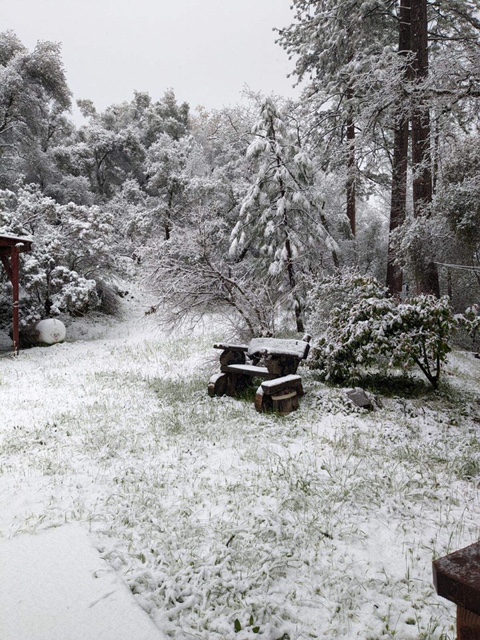
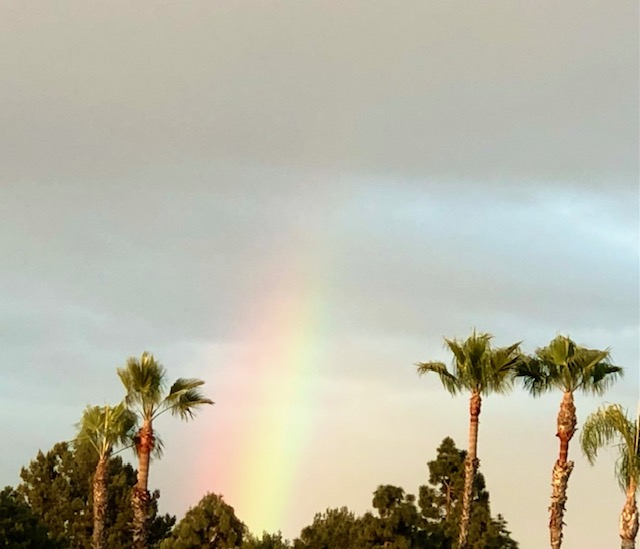
And gifts from Mother Earth:


Snow in North Fork (a photo was sent to me by a friend from the North Fork) and a rainbow when Eric too me out for my birthday dinner.

I feel grateful for everyone and everything who thought of me on my birthday.

My birthday present for me was a day where I give myself time and carefree day without any worries or pressure, which is truly the most luxurious birthday gift.

Love,
Sanae ❤️

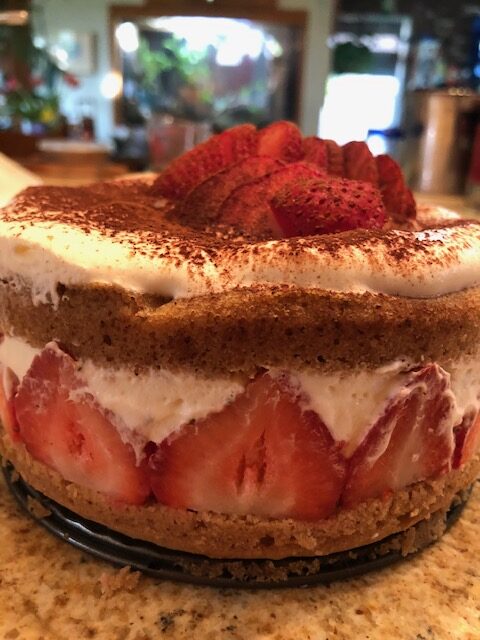
P.S. A few days after I posted this blog, Eric baked a cake and made my favorite strawberry shortcake for my slightly late birthday!
It looks cute, right?
How did it taste?
”…mmhmmhmm”
I wish you could taste it.

Seasonal Handwork-Miso Making

Ever since childhood, I have been interested in making things that take time and effort.

It’s nice to have convenient and easy things to do, but I was not interested in them. 

My elementary school teacher and my parents called me “slow” since I took longer than others to do many things.
So, when I started practicing macrobiotics, I thought that macrobiotics, which require careful time, were suitable for me.

Many people say that macrobiotics is difficult and challenging, but what macrobiotics teach is the principle for humans to live a healthy life, so it’s not complicated.
But it changes by season, the type of people’s constitution, and their health condition, so since we (humans) are so out of touch with nature, it has become too complex.

Of course, it takes time and effort to be done.

But learning anything for the first time isn’t easy; you’ll improve with practice and practice. For example, playing the piano in music or playing tennis in sports can only be done easily if you are incredibly talented.

The reality for me is that after getting sick and being unable to walk due to a near death car accident, I had to think about my own lifestyle and how to live. Then, I practiced what I could and practiced again and again, and finally, I could do it comfortably.

In fact, it wasn’t until I had more leeway in my life that I started making traditional Japanese handmade items and other items little by little. I now make about 10 different products (e.g., Miso, Yuzu pepper, Rice bran pickles, Natto, Orange marmalade, Umeboshi plums, Ume plum enzyme juice, Ume plum sauce/jam, Rakkyo pickles, Red ginger pickles, and Dried whole persimmons) every year with help of my husband, Eric.

I’m a tortoise, so I slowly prepare to welcome the new year every year. At the beginning of January, I start writing down my goals for the year ahead, and then February arrives.
Around that time, I start making miso.
It is the perfect time to make miso.
Because the temperature is low, fermentation can take place slowly and thoroughly.
During the cold season, there are fewer bacteria, which can prevent mold growth.
One of the reasons is that you can use soybeans that have just been harvested in the fall.


Nowadays, many people use miso within about three~six months of making it, and miso companies also need a place to store it. If it takes time, it will take time to sell, so it seems like a sad situation that more and more companies are selling their miso in a short time after they make it.


In fact, when miso is left to age for two or three years, amino acids and vitamins that are not present in soybeans or are present in small amounts are produced through fermentation, increasing its nutritional value. Soy protein is broken down by enzymes and becomes water-soluble, and some of it becomes amino acids. Among them are eight types of essential amino acids that are essential for maintaining life, as well as vitamins (B1, B2, B6, B12, E, K, niacin, folic acid, pantothenic acid, piotin) and minerals (sodium, potassium, calcium, It contains abundant nutrients such as magnesium, phosphorus, iron, zinc, copper, iodine, selenium, chromium, and molybdenum), monounsaturated fatty acids, polyunsaturated fatty acids, and dietary fiber.
The salt mixes well with the soybeans, giving the dish a rich, umami flavor rather than a salty taste.


Therefore, I recommend using miso that has been aged for 2 to 3 years, but these days, aged miso is almost impossible to buy and is inconvenient.
We can’t find aged miso sold in the Japanese market and health food stores where we used to buy it here in the United States (near Los Angeles), so the miso they sell tastes salty.
I haven’t lived in Japan for a long time, so I don’t know much about what kind of miso is sold in Japan, but aged miso is probably hard to find in Japan as well.

So, I decided to make my own miso a while ago after I recovered from stage IV cancer, only weeks live.
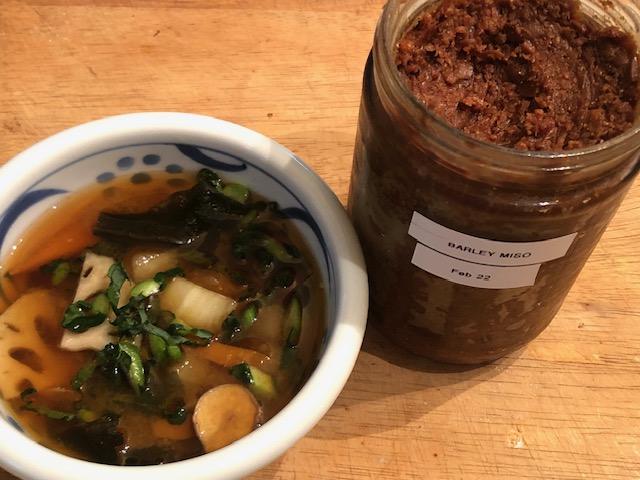
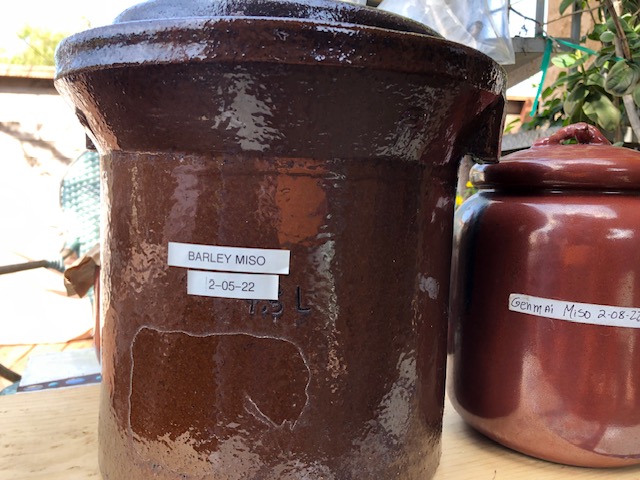
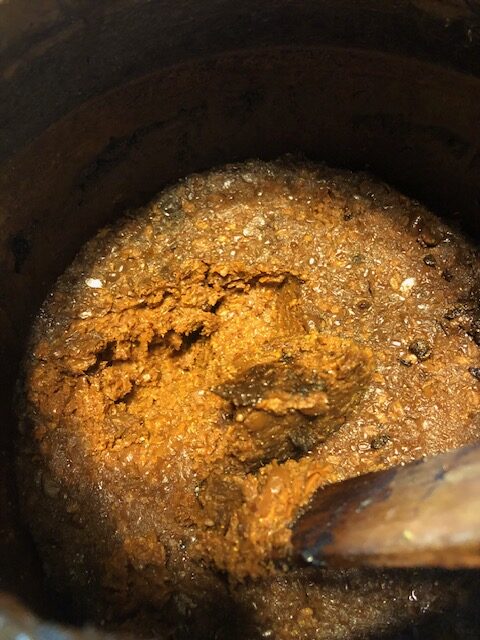
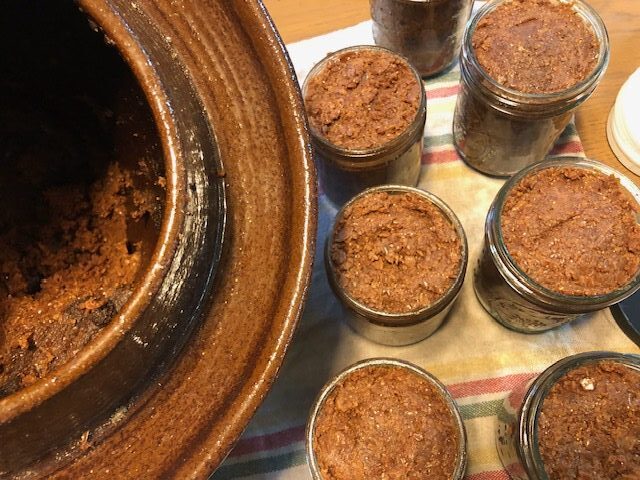
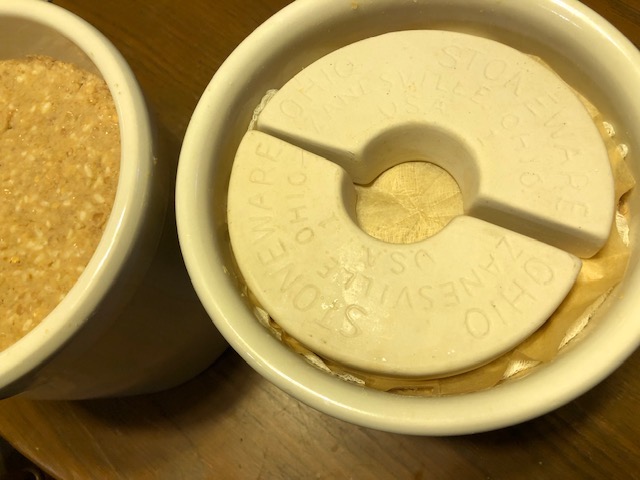
This year, I pulled out the miso in the earthenware pot I made two years ago. The aroma and taste are great. I wish I can share them here.
Of course, I have so much love for this miso because I have been growing it with my care for two years.

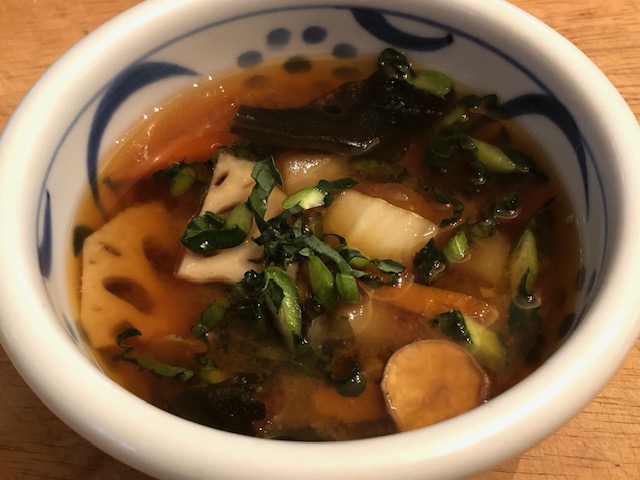
I made miso soup with my two-year-old miso.


I only needed to use less than the usual amount of miso I used to get the flavor.
It was so delicious!
The miso can be used in various dishes such as stir-fry, stew, dip, and miso dressing and many more.

You can easily see the benefits of miso on the internet if you look into it.
Promotes digestion and absorption – has the effect of working on the digestive organs.
When you absorb the salty taste of miso soup into your body at the beginning of a meal, your stomach and intestines begin to move, allowing for efficient digestion and inhalation, which reduces the burden on your body.

Suppression of blood cholesterol levels
Soybean lecithin and soybean peptides contained in soybeans can suppress the rise in blood cholesterol.

It has also been reported to have other beneficial effects, such as neutralizing nicotine, preventing cancer, and preventing aging. And much more!


Making your miso is not difficult, so why not give it a try?

Here is the recipe I have been using.

Miso making recipe:
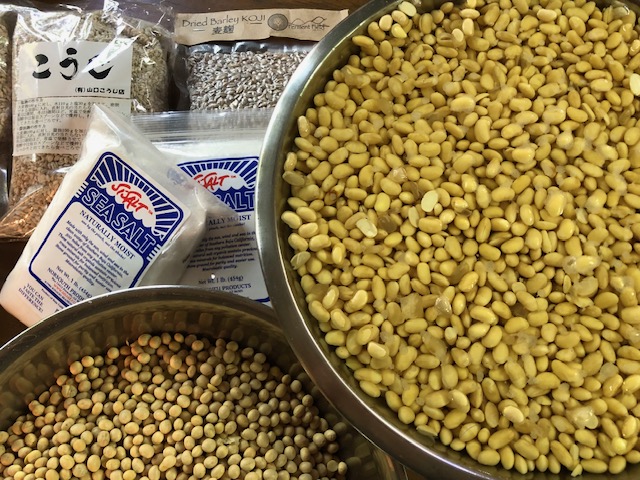
・Organic dried soybeans) 300g
・Koji (rice malt or barley malt) 200g
・Sea salt 120g
・Earthware container/pot
・Storage cotton cloth

What to prepare

・Stainless steel pot, colander, bowl,
 · Ladle
・Wooden pestle,
・Organic cotton cloth or Cheesecloth
・Baking sheet
・Weight
・Vinyl gloves (only for those who are interested)
・Alcohol spray or shochu or salt (only for those who are concerned)
・Stainless pot, calendars, bowl, 
・Vinyl gloves (only for those who are interested)
・Alcohol spray or shochu or salt (only for those who are concerned)


1. Wash the soybeans 2 to 3 times.
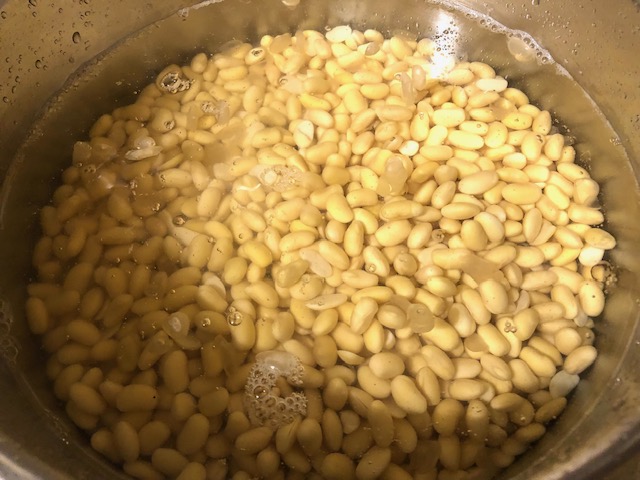
2. Add three times as much water as the soybeans and leave it overnight.                               Soybeans will expand by 2 to 2.3 times. It takes about 8~12 hours! Remove the skins from the float beans to the top and drain the water.


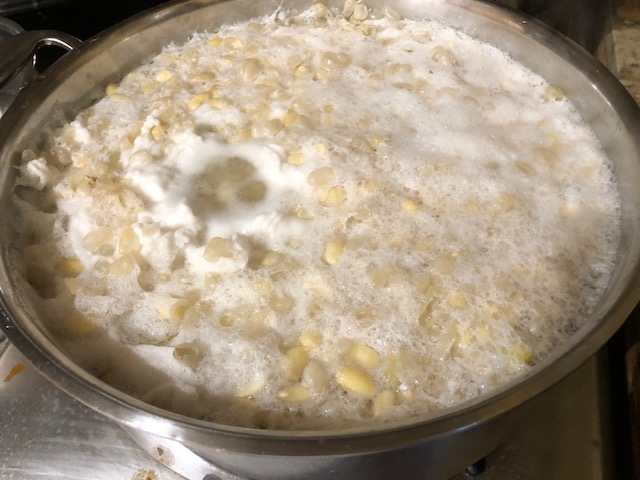
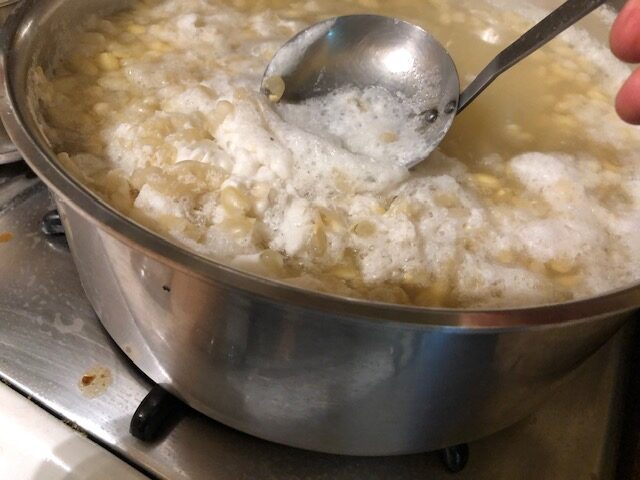
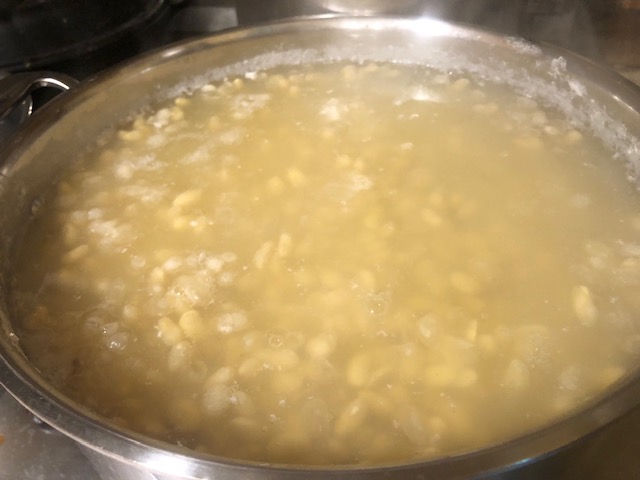
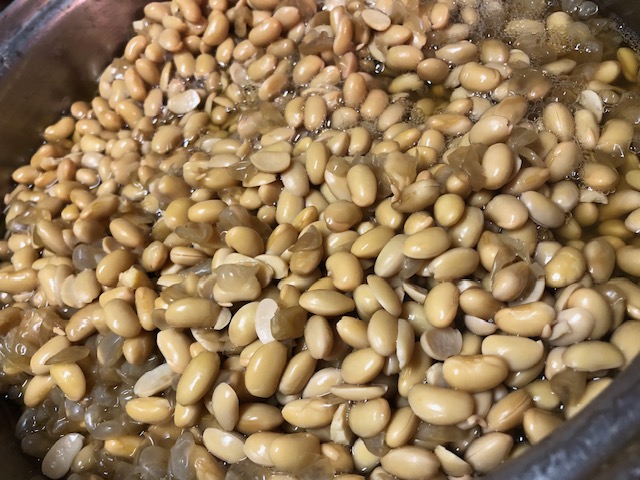
3. Add enough fresh water to cover the soybeans, heat over high heat at first, and once it boils, remove the scum. Then, boil slowly over medium heat and add the water if you need. Take a form out with a ladle. It depends on the pot, but the approximate cooking time is about 3~5 hours.


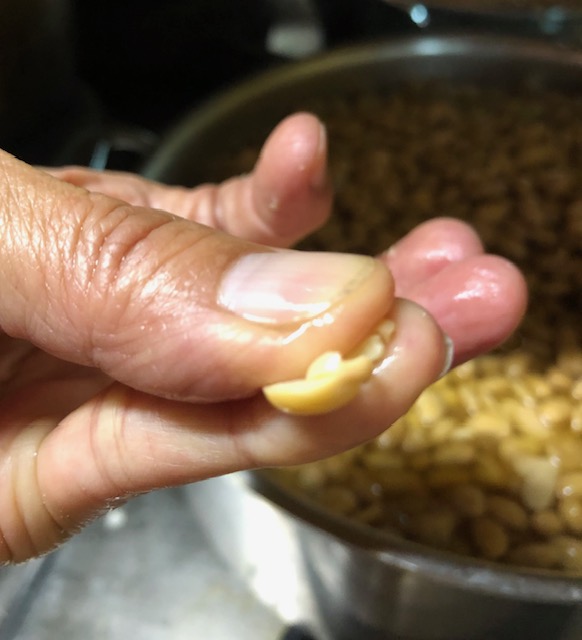
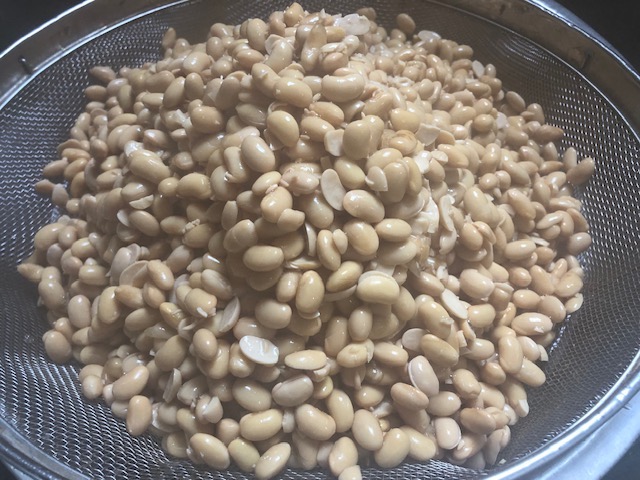
4. When the soybeans are soft enough to be crushed between your thumb and little finger, turn off the heat and drain the broth using a colander.

Keep some cooked broth to add to making miso later.
Boiled soybeans are perishable, so I recommend making miso as soon as possible.
(if you don’t prepare them right away, store them in the refrigerator.)


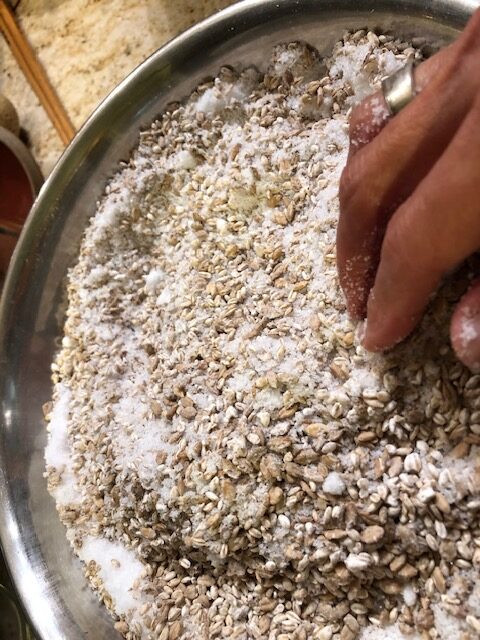
5. Now, make the shiokiri koji.


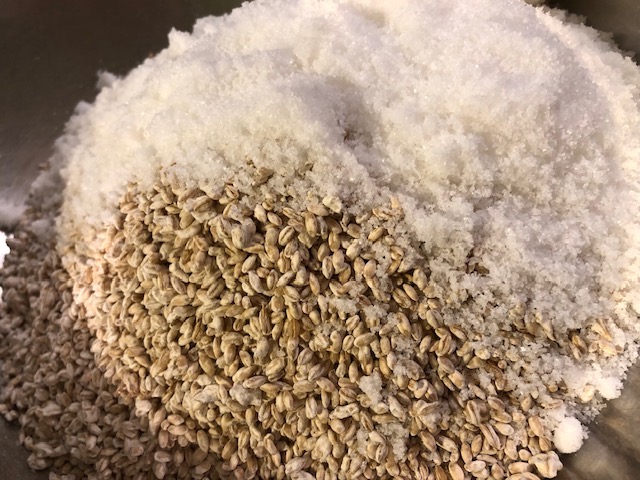
Add sea salt to naturally thawed koji to mix them well.
I usually mix a little by little by hand.


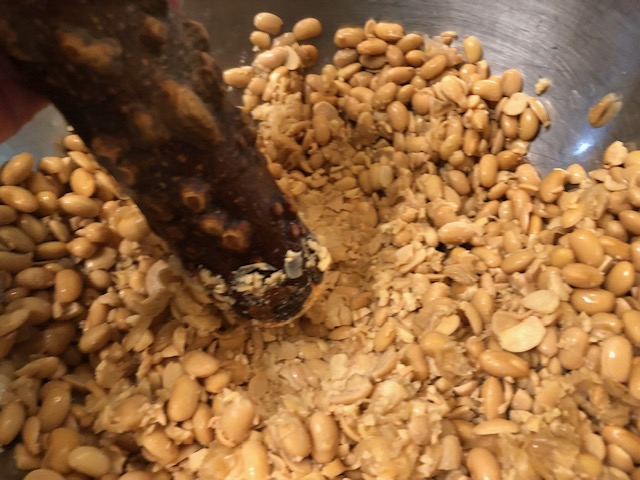
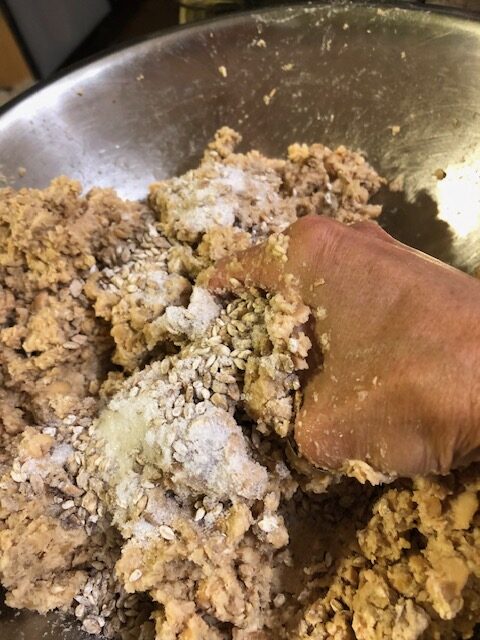
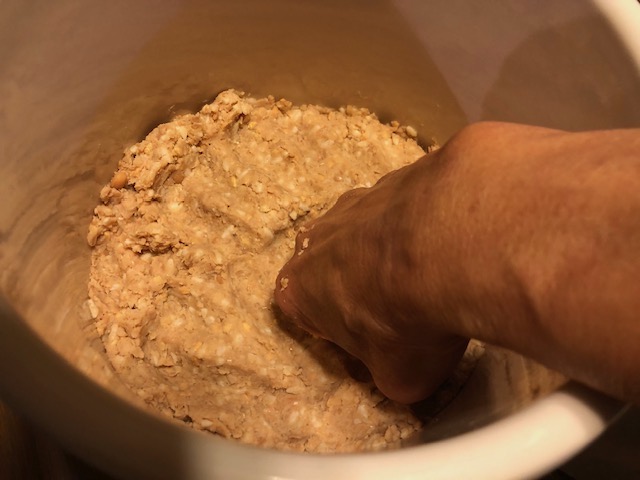
6. Place the boiled soybeans in a bowl and crush them by a wooden pestle and hand until they are no longer in shape. I like to keep some of the beans as they are so they have texture when miso is made.

It’s easier to mash it when it’s warm.
(if it’s been refrigerated, you can warm it up a little.)


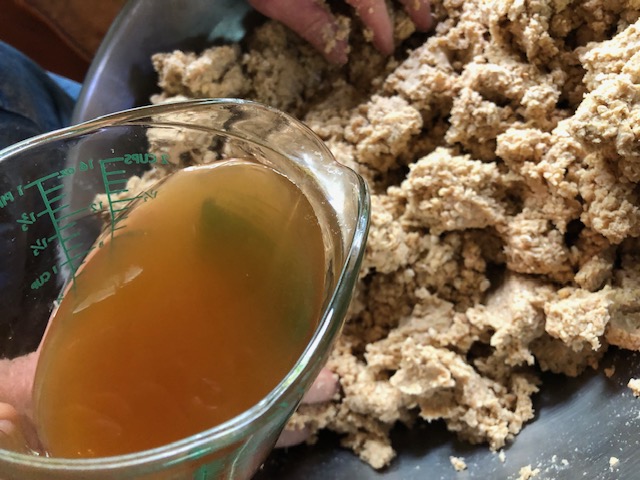
7. Add salted koji to the soybeans and mix. Check the moisture level and add a small amount of cooked soybean broth (usually around 10 to 50 ml) to reach the consistency of your earlobe. The secret to making it delicious is to mix it well.


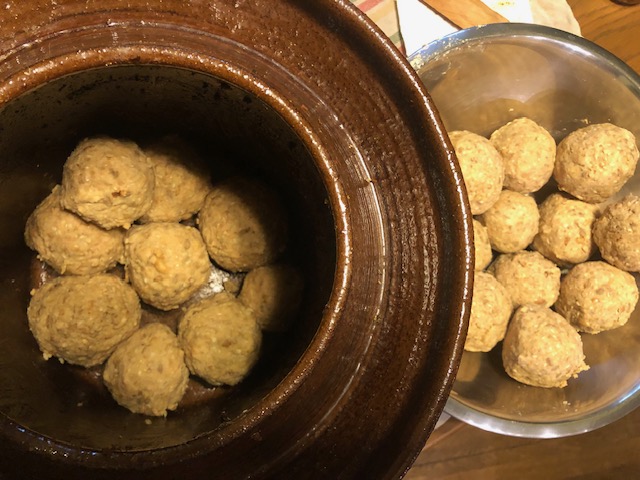
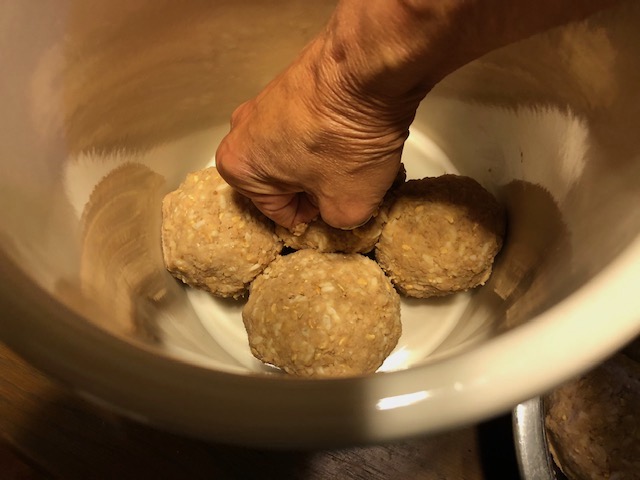
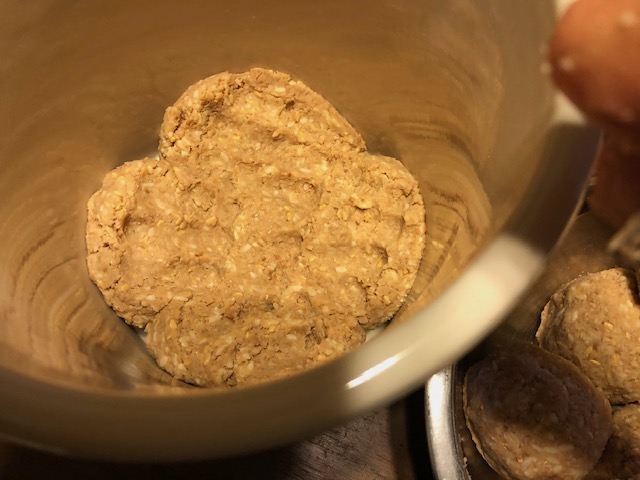
8. Mix until there are no leftover soybeans left, then roll a handful at a time like a rice ball. Then, place them one by one in a container (I use a ceramic jar) and press them down to flatten the surface while removing the air. The sides are prone to mold, so make sure they are flat.


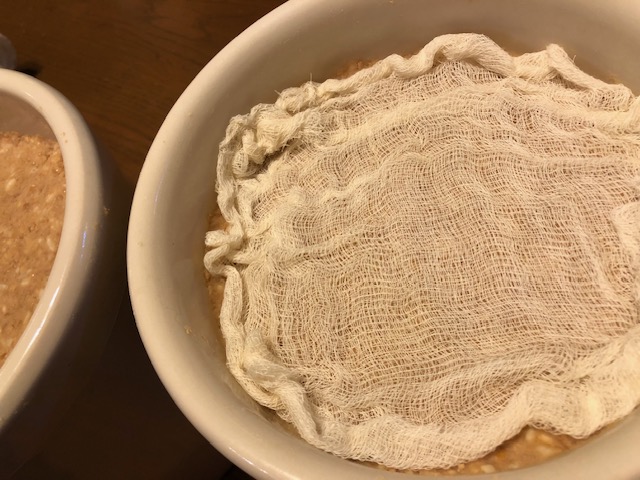
9. Spread organic cotton cloth, thin cheesecloth, etc., flat on the surface, and place a baking sheet on top to prevent air from entering.

Some people find it practical to spray alcohol on the surface (if you don’t have one, sprinkle shochu or salt lightly and evenly) to reduce the amount of mold that grows, but I don’t do that.


10. Finally, add a weight (preferably about 30% of the weight) and put a label to complete.

Where to Place:
Place the container away from direct sunlight. No Refrigerators! Miso has the property of absorbing odors, so avoid placing it near things with strong odors.
If you are planning to do Tench Gaeshi, I recommend that you write down the date of preparation, around the time of Tench Gaeshi and when it will be ready to sue so you don’t forget.

Tenchi Gaeshi:
Tenji Gaeshi is good to do between mid-July and early August. Remove the weight, baking sheet, and cloth, then remove any black mold that has formed on the surface. The whitish stuff is called acid-film yeast and is not harmful to the body.
However, mixing it with miso will spoil the flavor of miso, so try to remove it as much as possible. Flip the miso upside down to incorporate air. It eliminates the carbon dioxide produced during fermentation and introduces oxygen to promote better fermentation. This is sealed again, as shown in numbers 8 to 10 in the diagram on the left, and left to ripen until winter.

Purpose of Tenjigaeshi:
・Remove the mold so as not to spoil the flavor of the miso.

・Turn it upside down and release the generated gas.

・ Sends oxygen

・Promotes enzyme activity

・Uniform the hardness


Completion
The expected completion date is at least one year. Miso becomes more delicious after the hot summer (possibly two summers), and you can start eating it as early as you like after the summer has passed. I recommend two years aged miso.

When it is finished, remove any mold and turn it upside down to make it even. Additive-free miso will continue to ferment, and the color will darken, but it will not spoil and can be enjoyed for a long time. If you want to stop fermentation, put it in the refrigerator. If you use it while fermenting it, store it at room temperature and remove the mold before eating.


If any of you make Miso using my recipe and have questions, let me know.

Love, 

Sanae ❤️

New Year Goals – Ink Making

January is the time for me to write down my goals for the new year.

I have been going to see New Year Sunrise to worship it on New Year’s Day for about 30 years.

I plan my new year goals according to the lunar calendar, so I spend the time until the Lunar New Year in February with an awareness of what I want to do in the New Year.

January is the perfect time to start writing down what’s on my mind, what I am thinking, and what I am feeling. I like writing down my goals and what I can accomplish.

Review what I wrote last year and see what I accomplished and didn’t.

If I had a goal that I couldn’t achieve last year, look at it honestly and think about whether I want to work towards the same goal this year.

Sometimes, my interests and feelings change, and I don’t continue. It’s a good experience to accept things and my changes and not judge them.

One of my goals in 2024 is to “Learn How to Make Ink” with natural materials by taking a workshop at Maiwa School of Textiles with TIM McLAUGHLIN.


Why did I decide to take this workshop as my New Year goal?

Well, something happened when I was five, and my parents changed the kindergartens I was going to. There was a famous Japanese calligraphy “Shodo” master who was the younger brother of the director of the new kindergarten I started attending.

I began learning Japanese calligraphy, “Shodo,” under this master.

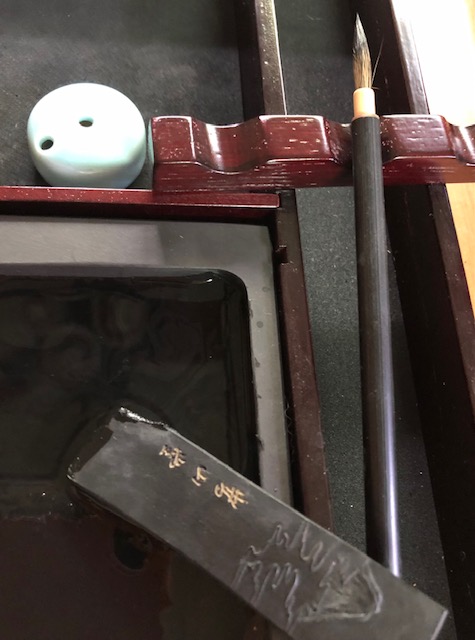
At the beginning of the classes, I had learned how to make Sumi ink and doodling with a Japanese Calligraphy brush.

For some reason, I liked mixing Sumi ink stick with water and rubbing it by hand on an ink-stone.
I forget how much time passed when I was rubbing the Sumi ink stick, and my teacher sometimes came to check on me and said, “Are you ready to dip your brush in Sumi ink?”

Maybe I was in a zen state even at a young age, hahaha!
It could be because the scent of Sumi ink and the sound of Sumi ink rubbing the Suzuri (Inkstone) relaxed me.

I discovered that I could make Sumi ink darker than midnight color and Sumi ink color to match dawn, which was closer to gray.

The color of the Sumi ink changed depending on the movement of my hand and the vibration of my feelings. 

Slowly moving my hands and making ink gave “the shy little Sanae” confidence and helped her calm down.

There was a time when my teacher encouraged me to exhibit many of my works in calligraphy exhibitions at art museums, and I won numerous awards.

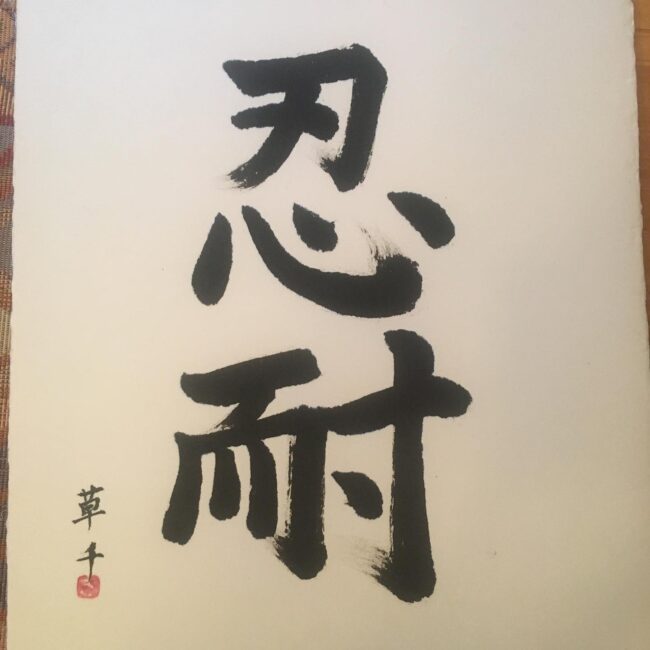
Japanese Calligraphy “Shodo” – 「Nintai」English meaning Patience I did for a friend request


Then, when I was in elementary school, I noticed that my father used fountain pens, and I was drawn to them so much. I remember buying my first fountain pen when I was 13 years old.

I wanted to find my favorite color of ink for my fountain pen. 

Green ink was the color for me!

After finding green ink, I sent postcards and requested songs every week to the late-night radio program “Ama-chin’s Young Request” in my hometown of Nagoya.

I could request songs over the phone, but since so many people were calling, I couldn’t always get through, so I sent postcards. 

I am sure I was spending more time writing these postcards than studying for school.

I used my pen name, “Green Puff” (this name came from the popular Japanese cotton facial puff name Clean Puff) because I used a green ink fountain pen, and it sounded cute.

Since everyone sent postcards with a ballpoint pen and no one sent them with fountain pens and colored ink, especially green, DJ Ama-chin chose my card every week and played my favorite songs. It was a sweet memory I almost forgot.


September 8th, 2001, I had a near-death experience in a car accident with severe injuries, and the doctors told me I would not be able to walk anymore. You might be able to imagine how much I struggled for a long time. I was bedridden for one year, painful physical therapy, and learned to live a wheelchair life.

One day, right after I learned to use my wheelchair, I went to orientation for disabled people’s public city van. I met a woman whose name was Evie, and she introduced me to taking a pen calligraphy class at Emeritus at Santa Monica College. This story you can read here.

Although it is different from Japanese calligraphy, I thought the attitude of preparation and writing was similar. 

It calms the mind and makes the atmosphere quiet.

While I practice calligraphy, I notice my dogs ​​and cats family all relax.

One of my calligraphy and drawing of Lindisfarne Gospel from my practice notebook.


I continue to practice pen calligraphy, and a few years ago, I was able to write my own haiku in pen calligraphy and submit “Lotus” with a watercolor hanga print as my first artwork for the college art show.

It reminded me of the old days when I was entering my “Shodo” Calligraphy yo the museum.

So, even though I was disable I still could create art.


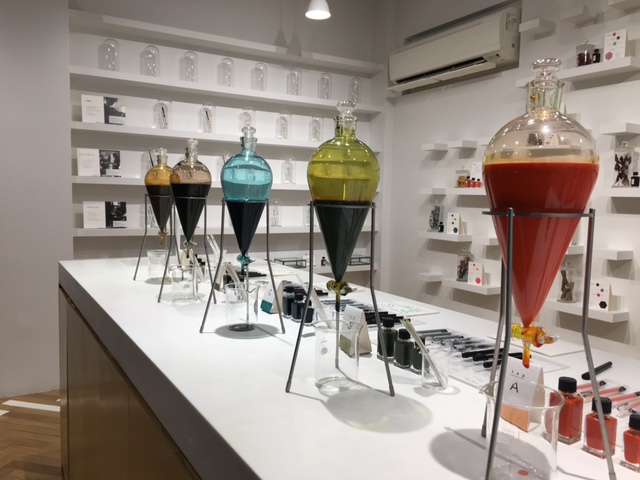
There is one more thing, which is ever since I mixed ink colors at Kakimori’s Inkstand in Tokyo in 2019 after undergoing six cycles of Chemotherapy to treat Stage IV Non-Hodgkin’s Lymphoma cancer when I was diagnosed with “Only Weeks to Live” in 2017. (you can read it here)

The Inkstand had ten basic colors to create/mix many colors, and I was fascinated to create three different colors of my own. 


I was also interested in whether there was a way to make ink (not just mixing) using natural dye materials. 

I was excited to learn that Maiwa School of Textile was offering “The Ink Making Workshop.”

I want to make my original “ink” colors someday and hope to be able to create new calligraphy art for college art exhibitions.


So, these are the reasons why I have made “Learn How to Make My Ink” one of my goals for 2024.

It is a seven-week workshop and it has just started.
The first week was Introduction and Module 1, in which I learned what materials and supplies I needed to prepare for making ink.
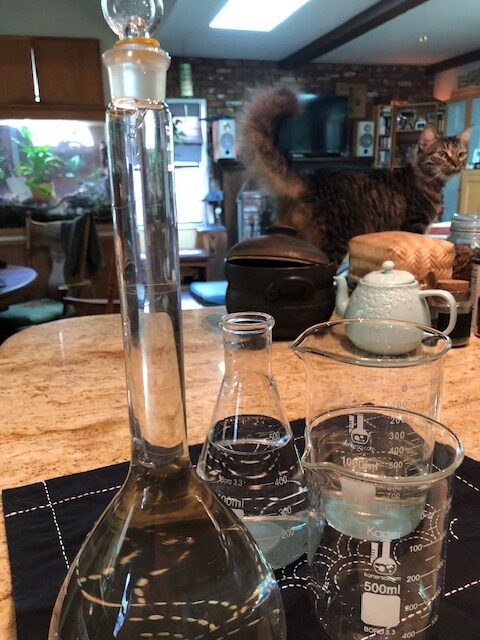
I am someone who loves glassware; my excitement grew when I saw that the list included glasses such as beakers, flasks, and cylinders.
I liked the fact that I could use rainwater to make ink.
The perfect timing is that it had been raining the last few days here, so I corrected the rainwater.

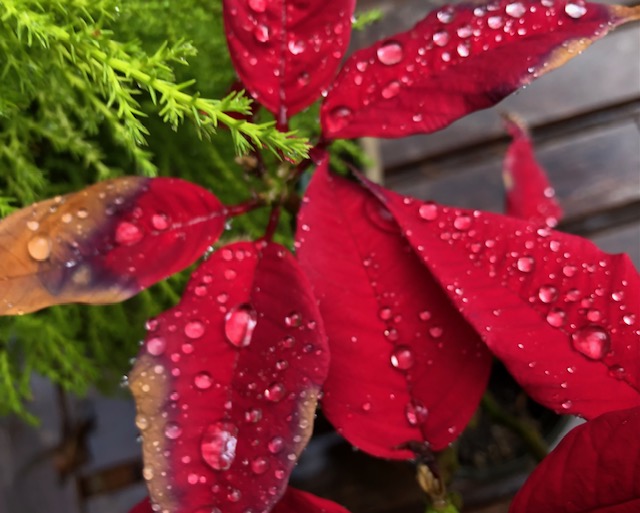
Raindrops over holiday poinsettia.


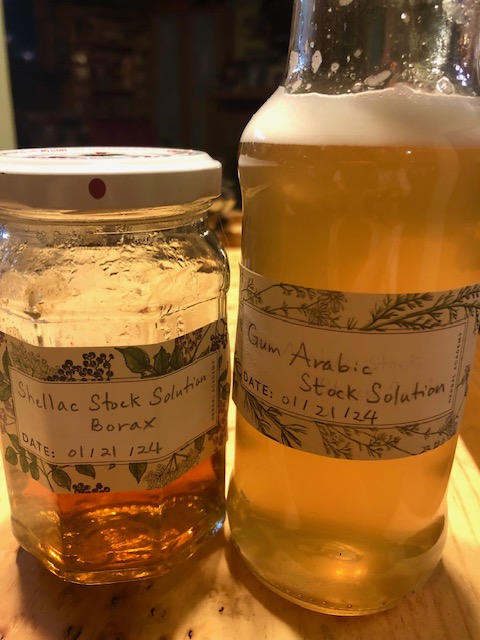
This weekend, I got all the materials and supplies to start making Gum Arabic Solution and Shellac Solution.
Doesn’t these glass containers remind you of a chemistry class?


Making Gum Arabic Stock Solution was like making almond milk late and took only a little time.
Shellac Stock Solution was like making caramel syrup first.
The instructor, Tim, said,” It would take one hour to make,” but it took me almost two hours. I think my bath water to melt Shellac was not deep enough, so I will know the next time.
Anyway, I enjoyed a slow pace on Sunday time to complete it.

This workshop has been much more exciting than I expected so far.
I can’t wait to make my original color ink.


I look forward to posting more photos on my Instagram and Facebook and writing about them on my blog again after I learn.


Love,

Sanae ❤️